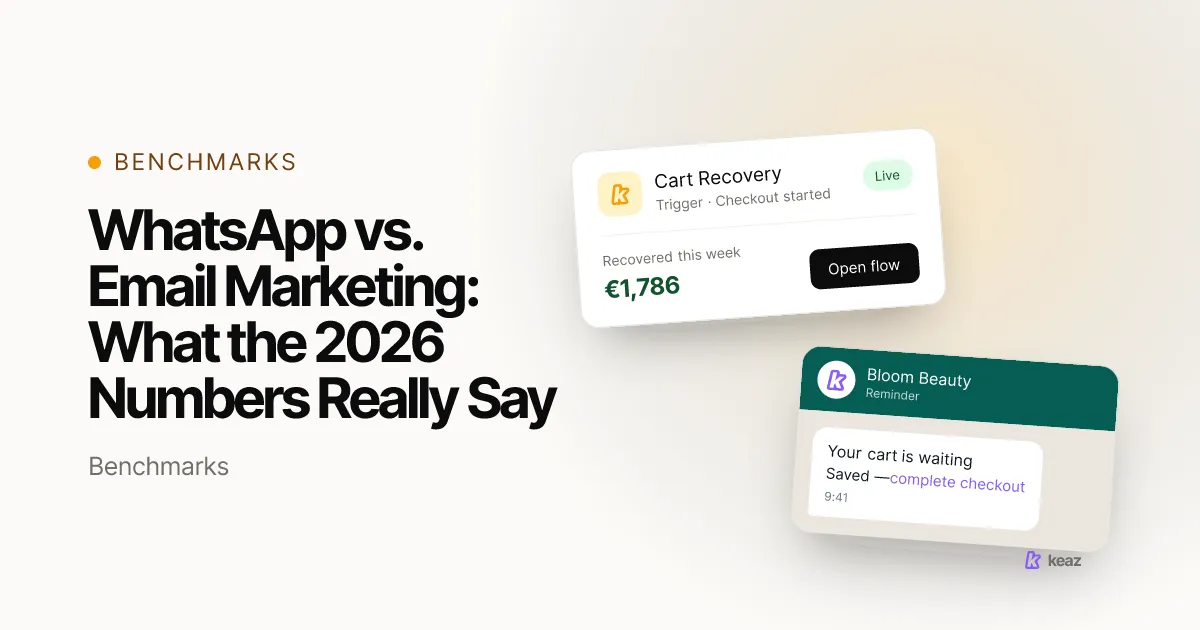
WhatsApp doesn't replace email — it reaches the 60–70% of your customers that email loses. On a shared audience, WhatsApp converts about 1.6× better, modeled conservatively.
- Delivered-to-read rate on WhatsApp: 90%+ · email open rate: 30–40% (industry band)
- Mature WhatsApp programs add 6–18% of annual revenue — we model the lower half
- Biggest single lever: cart recovery at ~40% of WhatsApp revenue
How do WhatsApp and email marketing actually differ?
At its core, WhatsApp vs. email marketing describes two very different ways to reach the same customers. Email is a broadcast channel: you send a message into an inbox and hope it gets opened. WhatsApp is a conversational channel: the message lands in the same chat thread your customers use with friends and family — with consent, read receipts, and the option to reply.
For Shopify DTC merchants, the key takeaway up front: it isn't an either-or question. WhatsApp doesn't replace email; it picks up exactly the customers email no longer reaches. This article weighs both channels soberly — with conservative assumptions you can defend internally.
WhatsApp vs. email marketing: the core 2026 numbers
Anyone deciding on marketing channels needs defensible ranges, not opinions. The figures below come from published platform benchmarks and are calibrated quarterly against real Keaz program data.
- Delivered → read: email 30–40% (opens) vs. WhatsApp 90%+
- Conversion rate on a shared audience: WhatsApp ~1.6× (conservative)
- Active rate of segmented sends: ~30% (standard assumption)
- Revenue contribution of mature programs: +6–18% per year
For context: published case studies regularly report 5–7× CVR uplift. We deliberately model 1.6× — the low end of the range. A number that holds up in a meeting is worth more than one that impresses.
Why does WhatsApp reach customers email loses?
Email has a structural problem: the inbox is the most contested place in digital marketing. Even a well-kept list only truly reaches the share of customers who still open mail at all. WhatsApp flips the logic — the message appears where people already communicate daily. Three gaps explain the difference:
- Reach gap: customers with a valid phone number but dead email engagement are practically unreachable by email — but not by WhatsApp.
- Timing gap: cart recovery lives on a short decision window. A message read within minutes beats a mail opened — if at all — the next day.
- Format gap: buttons, quick replies and conversational flows make WhatsApp interactive. Email stays one-way.
Rule of thumb: use WhatsApp first where purchase intent already exists (cart, repurchase, shipping) — not for cold reach.
What's realistic per vertical?
The effect isn't evenly distributed. What matters is repurchase frequency, not average order value: Pet and Beauty benefit most, Home & Living least — though there cart recovery on high baskets carries the weight.
- Pet: 1.10–1.60% of annual revenue per month (≈13.2–19.2% annualized)
- Fashion: 0.90–1.40% per month (≈10.8–16.8% annualized)
- Beauty: 0.86–1.34% per month (≈10.3–16.1% annualized)
- Home & Living: 0.48–0.80% per month (≈5.8–9.6% annualized)
All eight vertical rates with rationale are in the complete guide. The biggest single lever is the same in almost every vertical: WhatsApp cart recovery, contributing around 40% of WhatsApp revenue.
What does WhatsApp cost compared to email?
Email is cheap per send — that's its strongest argument. WhatsApp carries a platform fee plus conversation-based Meta fees, making it more expensive per message. But the fair comparison isn't price per send; it's cost per incremental revenue: a 1.6× higher conversion on a channel with a 90%+ read rate justifies the higher unit price in most DTC setups.
In practice: email stays the low-cost foundation for newsletters and broad lifecycle tracks. WhatsApp is deployed precisely where the higher conversion carries the higher price — intent-driven flows. Total cost stays controllable while incremental revenue is added on top.
Is WhatsApp marketing GDPR-compliant?
Yes — with explicit opt-in. Consent must be documented, purpose-bound and revocable at any time. The cleanest path is to collect it directly in the Shopify checkout, separate from the email consent. WhatsApp is not a channel for purchased lists — the quality and provability of consent protect you both legally and on deliverability.
WhatsApp or email — which should you choose?
The data doesn't support a "WhatsApp instead of email" thesis. It shows a layered model: email stays the foundation for newsletters and lifecycle, WhatsApp captures the revenue lost in the inbox. If you use Klaviyo, you add WhatsApp — nobody migrates.
A pragmatic order: if you're just starting, email plus a single WhatsApp flow (cart recovery) is enough. Once that pays off, add shipping updates, win-back and repurchase. That way you build WhatsApp vs. email marketing not as competition but as two channels with one shared strategy — measuring from day one which euro comes from where.
Frequently asked questions
Is WhatsApp marketing GDPR-compliant in Germany?
Yes — with explicit opt-in. Consent must be documented, purpose-bound and revocable. Collect it cleanly in the Shopify checkout, separate from email consent.
Doesn't WhatsApp marketing annoy customers?
Frequency decides. Intent-driven flows (cart, repurchase, shipping) reach 30%+ active rates — unsegmented broadcasts drop to 15–25% and risk blocks. Quality over quantity.
Do I need an agency for this?
No. WABA setup, verification and a first flow are doable in about 15 minutes.
Bottom line: don't pit the channels against each other. Keep email as your cost-efficient base, layer WhatsApp onto high-intent moments, and measure incremental revenue from the start. Want to see how much revenue you're leaving in the inbox? Run the forecast.
Frequently asked questions
How do WhatsApp and email marketing actually differ?
Why does WhatsApp reach customers email loses?
What's realistic per vertical?
What does WhatsApp cost compared to email?
Is WhatsApp marketing GDPR-compliant?
WhatsApp or email — which should you choose?
Written by
Keaz Editorial
The Keaz team writes about WhatsApp marketing, automation, and growth for commerce brands.